
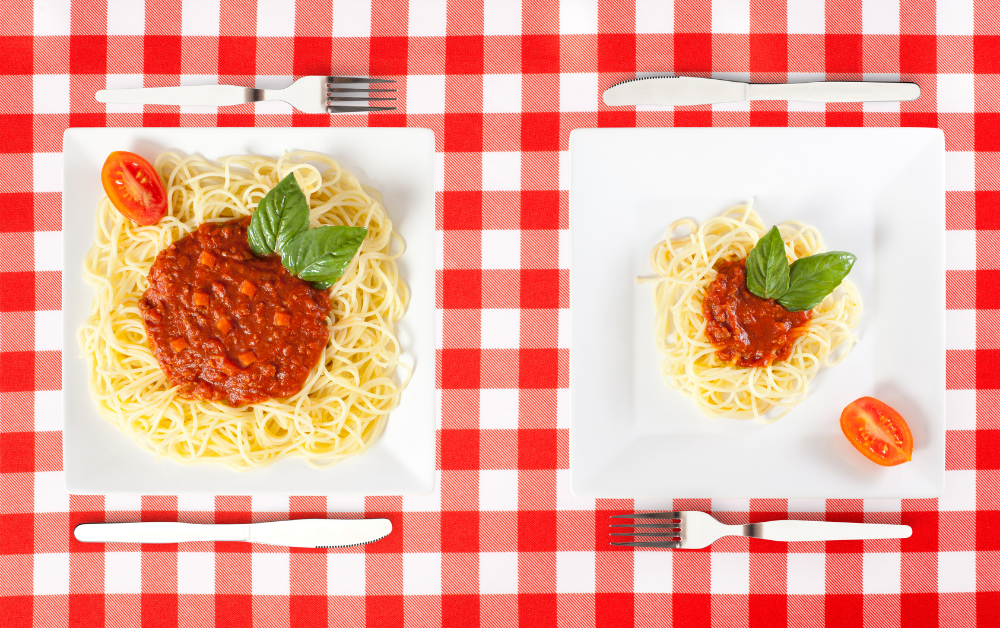
Eating healthy foods is just one part of your overall nutrition. It’s important to pair the right foods with the right portions. For example, eating healthy foods in large quantities could cause you to gain weight instead of lose weight.
Portions refer to the amount of food that you eat at a time. This food could be prepared in your own kitchen or could come from a restaurant. On the other hand, a serving size is a predetermined measurement, like 8 ounces or 6 crackers, that is used to generate the food’s nutritional information (1). So, a food may come packaged as a single portion but could contain multiple servings.
Reading Labels
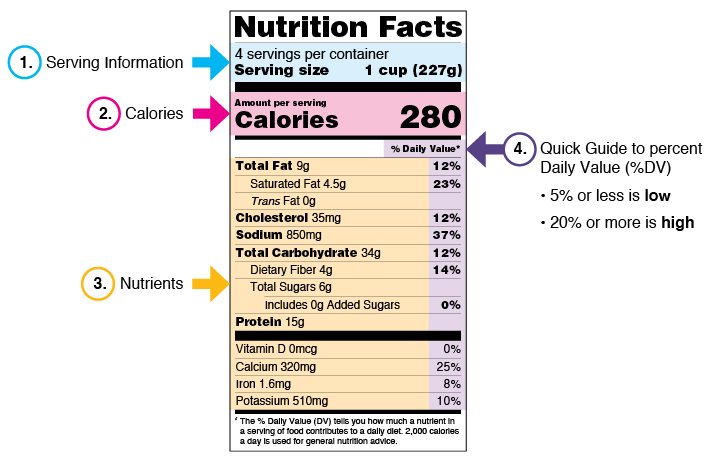
Since we brought up nutrition labels, now is a good time to review the basics of a nutrition label. According to the FDA, a nutrition label has 4 main parts: serving information, calories, nutrients, and a quick guide to percent Daily Value (%DV) (2).
https://www.fda.gov/food/new-nutrition-facts-label/how-understand-and-use-nutrition-facts-label
Let’s review each of these sections.
Serving Information
The serving information is what we referenced earlier. It is a number of servings within the entire package. Another great thing to note is that the serving size usually reflects the amount of the food item that people eat or drink; it is NOT a recommendation of how much you should actually eat.
When monitoring your food intake, pay attention to portion sizes and how much of something you are actually eating. Your portions may actually be larger or smaller than the recommended serving size — and that’s okay!
Calories
The next section is dedicated to calories. The number of calories displayed is the number of calories per serving. In other words, it is a measurement of the energy you would get from eating the serving size indicated.
Nutrients
The nutrients section is one of the most important sections of the label. It contains how much of key nutrients are contained in the food. This measurement is also based on serving size. The section also includes nutrients to watch out for, like saturated fat, trans fat, added sugar, and sodium.
You might be wondering what the difference is between total sugar and added sugar. Many foods naturally contain sugar, like fruit. However, some recipes add more sugar for taste, known as added sugar. Try to avoid added sugars because they can increase your calories quickly.
Learn more about sugars in our post: Become a Sugar Detective.
% Daily Value
The %DV is located to the right of each individual nutrient. This number indicates the percentage of Daily Value for each nutrient in a serving of the food item. The %DV is based off of a 2,000-calorie diet, so the exact percentages might not equate perfectly to your body. If this is the case, you can use the percentages to help you gauge if a food is a good source of a nutrient.
The FDA indicates that 5% DV or less is considered a low nutrient per serving and that 20% DV or more is considered a high nutrient per serving.
Portion Pitfalls
Even when using EatLove, we know that monitoring your portions can be difficult. Restaurant plates can be HUGE. Snack mixes may actually contain several servings even if they are individually packaged. All of this means that you could be getting more servings of foods, more calories, more sodium, etc.
Here are some tips from the CDC on how you can avoid portion pitfalls (3).
- Take some restaurant food home. Instead of eating an entire plate at a restaurant, ask the waiter for a to-go box in the beginning and pack up ½ of your meal before you even take a bite. Likewise, you could split a meal with a friend. You may also want to avoid appetizers and desserts.
- Avoid the temptation of seconds. Delicious and healthy meals may make you want seconds. (We know the temptation!) However, if you are trying to stick to your health goals, you must be able to avoid extra helpings. After you have served the meal, you could place it in food storage containers and place it in the fridge to help discourage overeating.
- Snack when you’re hungry. Okay, this tip might seem a little odd in a post about portion control. But if you are hungry, your body is telling you that it needs food and nutrients. If you eat a healthy snack in between meals, you can avoid overeating when it is mealtime.
- Eliminate unhealthy options. Get rid of junk food in your house and throw out the candy bowl. By removing unhealthy options, you will force yourself to choose healthy alternatives, like fruit or vegetables instead. This is part of building an environment that’s better suited to helping you reach your goals.
- Be wary of large packages. Large packages indicate a lot of food inside. Consider dividing the package up into smaller portions to help you avoid overeating. For example, if you have a bag of chips, you could divide the chips into small snack bags to help you limit the number of chips you eat in one sitting.
- Don’t eat in front of the TV. It’s easy to continue eating snacks when you are watching TV or on the computer. Reaching into the bowl can turn into a mindless activity, so you might not even realize how much you’ve eaten.
Luckily, EatLove makes it a bit easier to keep track of your portions. On our platform serving sizes = portions. And we indicate how much of a recipe you should allot to each member on your meal plan to make it easier to divvy out meals to the family. If the meal is batch cooked, we also tell you how much to put away for leftovers.
Our portions are scientifically calculated based on the Harvard Healthy Eating Plate. Review the breakdown in Nutrition 101.
ASK YOURSELF THIS:
Do you usually try to finish your plate even if you are full? How often do you take seconds, or even thirds, at meals? Are you finishing the food on your partner’s or your kids’ plates?
TRY THIS:
Batch cook 1 meal this week and portion it out according to EatLove’s “How Much to Eat” on the recipe. Dish up the correct portions and then put the rest in the fridge.