
GLP-1 medications like Ozempic, Wegovy, and Mounjaro have created a paradigm shift in weight management. But this medical breakthrough comes with a major challenge that is often overlooked.
Most conversations focus on the so-called 'rebound,' the weight regain that can occur after stopping treatment, but the data points to a more immediate challenge that often derails success within the first few weeks: gastrointestinal side effects.
Up to 40% of patients report nausea, and nearly one in five experience constipation. These gastrointestinal symptoms are the most common reason patients stop therapy, often long before they see any benefit. The good news is that these side effects are predictable. They happen when the medication doesn’t align with a patient’s usual diet and can usually be minimized with the right nutritional approach, making them the most preventable barrier to success.
This is why we (at EatLove) frame it this way: focusing on personalized nutrition isn't just a "nice to have" for long-term health; it's the primary strategy for ensuring a patient can tolerate the medication long enough to see its benefits.
Nutrition isn’t just a generic handout. It only works when it’s personal. A plan succeeds when it fits a patient’s daily routine, includes foods they enjoy, and is actually realistic for them to follow. After working with more than 10,000 providers, we’ve seen that this kind of personalized approach is what really makes a difference.
1. The Tolerance Firewall: Why Adherence Comes First
For GLP-1 patients, the first challenge isn’t losing weight, it’s being able to stay on the medication. Because the drug slows digestion, meals that are high in fat, poor hydration, or irregular eating patterns can quickly become uncomfortable or even intolerable. The solution isn't to just "power through", it's a proactive, personalized nutrition strategy.
A generic handout suggesting patients ‘eat less fat’ or ‘eat more protein’ won’t work if it doesn’t fit their daily routine and preferences. It's the personalization that makes it work. A plan that shows a patient how to swap their usual high-fat breakfast for a high-protein option they also enjoy, or how to spread the protein they already like across smaller, more frequent meals, is a plan that combats side effects.
This is the key:
- Protein is spread evenly to reduce digestive burden.
- Total fat is lowered in a way that aligns with patient preferences.
- Fiber-rich foods and consistent hydration are integrated into their existing schedule.
This isn't just about comfort. Tolerance is the first test, and a structured, realistic nutrition plan is what allows patients to keep taking the medication and reach their goals.
2. Beyond Tolerance: The Threat to Metabolism
Once a patient is successfully tolerating the medication, the next challenge is protecting lean muscle and preventing malnutrition. Appetite suppression is a main benefit of GLP-1s, but without careful guidance, it can lead to nutrient gaps and muscle loss, putting metabolism at risk.
Recent research (Johnson et al., 2025) examining dietary quality in GLP-1 users found concerning patterns:
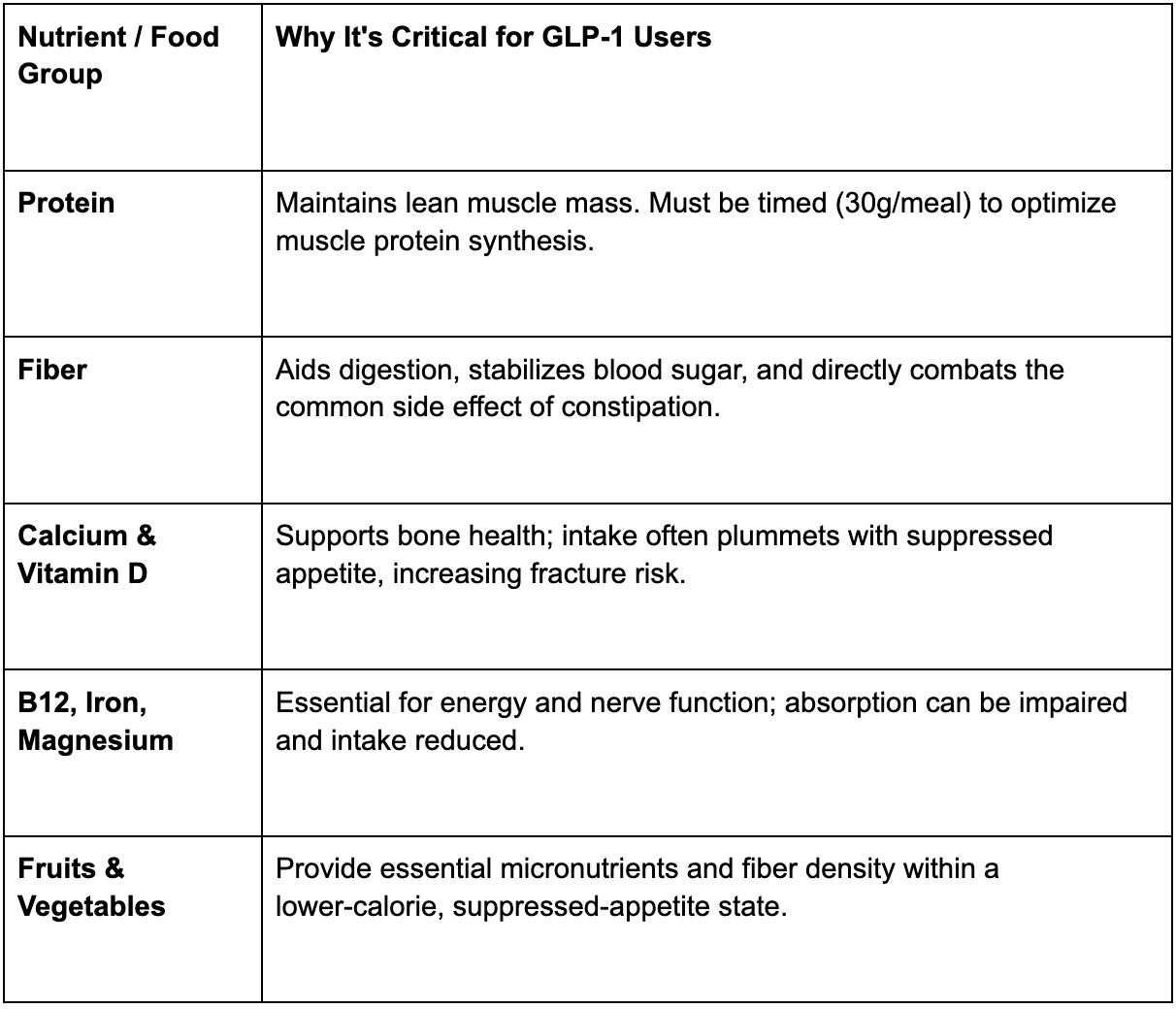
- Patients scored poorly on intake of fruits, vegetables, and whole grains.
- Critically, 40% of total daily protein was consumed at dinner, with only 19% at breakfast.
This back-loaded, low-quality intake is a recipe for metabolic trouble. During rapid weight loss, the body needs a steady supply of protein (about 30g per meal) to protect lean muscle. Without adequate protein, the body begins breaking down its own muscle for energy, which can lead to a long-term reduction in metabolic rate.
This sets a new standard of care: a ‘nutrition prescription’ with clear, specific targets designed to protect a patient’s metabolism. It is just as important as the medication itself.
Here's what matters:
3. Stopping the 'Rebound' Before It Starts
This brings us to the "rebound." The STEP 1 extension trial (Wilding et al., 2022) provides the startling data. One year after stopping semaglutide, participants regained two-thirds of their lost weight.
Why? Because the medication was treated as a cure when it is, in fact, a catalyst.
The drug creates a temporary "window of opportunity" where hunger is suppressed, and new behaviors can be built.
- If that window is missed because the patient quit early due to side effects, we have failed the patient.
- If that window is used only to eat less, we have failed the patient. Without learning new habits, their metabolic rate drops, and after stopping the medication, hunger may lead to quick weight regain.
If that window is used to build a personalized, "do-able" nutritional framework to teach them how to plan, shop, and eat for their new metabolism using foods they enjoy then we create lasting, sustainable change.
Weight regain isn't inevitable. It's the result of failing to solve for tolerance and personalization from Day 1.
4. The New Care Model: From 'Do-able' to 'Scalable'
The difference between success and failure with GLP-1s isn’t a lack of knowledge. Clinicians understand that nutrition support is critical. The real challenge is how care is delivered. There simply aren’t enough dietitians to support millions of patients, and short, sporadic visits with generic handouts can’t provide the ongoing, personalized guidance patients need.
The future of metabolic care is an integrated model that operationalizes personalized nutrition. This new framework has three requirements:
- It Must Be Truly Personalized and Prescriptive: It moves beyond generic advice ("eat more protein") to precise daily targets that are also built from the patient's food preferences, budget, and schedule. "Do-able" must come before "perfect”.
- It Must Be Continuous: Success isn't determined in the clinic, it's determined by the meals a patient eats between appointments. The model must provide "in-the-moment" guidance and meal planning to close the gap between knowing what to do and doing it.
- It Must Be Scalable: The only way to deliver this level of personalized, continuous care to millions is through technology. Platforms that allow a single provider to create, monitor, and adjust nutrition prescriptions for their entire patient panel are the core infrastructure of modern metabolic medicine.
Practices that adopt this integrated model are the ones who will break the dropout and rebound cycles. They are the ones who will turn a short-term pharmaceutical win into a long-term metabolic transformation.
A New Standard of Care: Key Principles
- Tolerance is the first hurdle: Side effects are often a nutrition problem, not a drug problem. They are the first, and most preventable, reason for failure.
- Personalization is the key to tolerance: A "do-able" plan that uses foods a patient already likes is the only effective way to manage side effects and ensure adherence.
- Muscle loss is the silent threat: Once tolerance is achieved, a precise protein prescription, distributed evenly, is the only way to prevent metabolic damage.
- Weight regain is a habit problem, not a medication failure. The drug provides a window to build habits, not replace them.
- The bottleneck is scalable personalization, not clinical knowledge. Practices need systems, not just more staff, to deliver this level of support.
Frequently Asked Questions: Counseling Patients on GLP-1 Therapy
What are the most common side effects, and how do I counsel patients?
The most frequent issues are gastrointestinal (nausea, constipation). Address them head-on as a nutrition challenge. This is where you prove your value. Don't just give a handout; create a workable plan.
- Empower them: "This is a normal, predictable reaction, and we will manage it together with nutrition."
- Be specific and personal: "We will manage this by finding lower-fat swaps for the foods you love, finding a hydration schedule that fits your workday, and spreading your protein across smaller meals that you enjoy." This empowers the patient and prevents them from abandoning therapy.
Do GLP-1s replace diet and exercise?
No. This is the most critical concept. Frame the medication as a catalyst that makes behavior change possible. Long-term success depends entirely on the personalized nutrition and lifestyle foundation built while on the medication.
Do patients regain weight after stopping GLP-1s?
Research shows many do. Be transparent about this. This is where you re-emphasize your clinic's integrated approach. Counsel them that the personalized nutrition and behavior strategies you are building now are their long-term "safety net." The medication is the tool to build the foundation; the foundation is what keeps the weight off.
What role does patient education play in long-term success?
It is everything. Patients who understand why they are eating 30g of protein at breakfast, why they must stay hydrated, and why their side effects are a manageable nutrition issue are empowered. They shift from being passive recipients of a drug to active participants in their own metabolic health. Education, combined with actionable, personalized tools, is the key to adherence and lasting change.
Medically Reviewed by: Alexandria Zozos, MS, RDN